September Recap

I LOVE fall. Like, probably more than a normal amount. Every year my husband tells me we already have enough fall decorations. And every year, I channel Lindsay Lohan in Mean Girls:“The limit does not exist.”
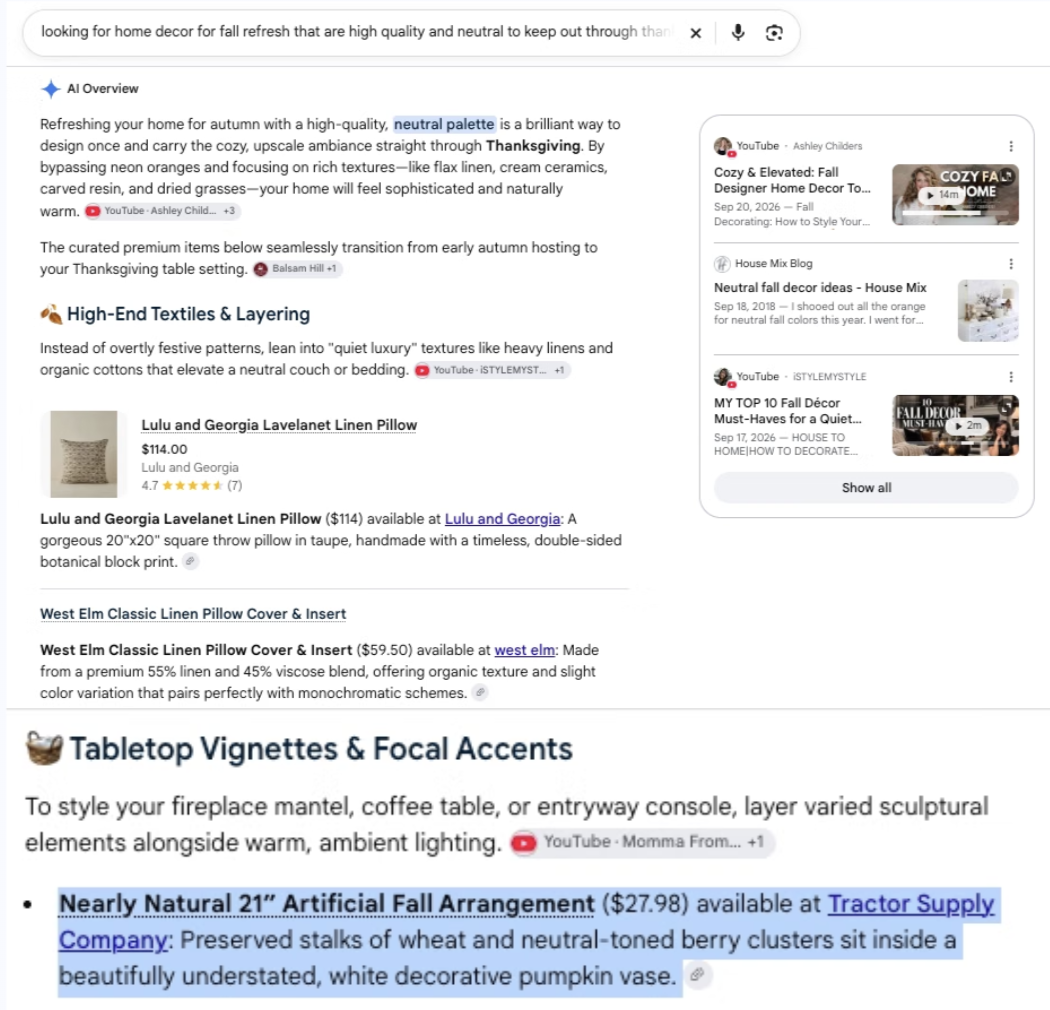
So naturally, I found myself on Google recently searching for fall decor that felt high quality and neutral enough that I could put it out now and leave it up through Thanksgiving.
I expected the usual suspects. West Elm. Lulu and Georgia. Maybe Pottery Barn. What I did not expect to see was Tractor Supply Co. Tractor Supply has fall decor?! Apparently, yes. And some of it is really good.
Google surfaced this $28 artificial fall arrangement from Tractor Supply in the middle of an AI Overview alongside products from brands I would normally associate much more closely with home decor. I clicked through, started looking around and realized they had an entire assortment I never would have known existed.
And that is such a perfect example of something we see with retailers all the time.
Most brands do not have a product problem. They have a product content problem.
Tractor Supply already had the product I wanted. They did not need to invent something new, launch a new collection, or somehow convince me that I needed fall decor (trust me, no convincing was necessary).
They just needed Google to understand that this particular product was relevant to someone searching for high-quality, neutral fall decor that could stay up through Thanksgiving.
That requires more than a basic product title, SKU and category.
It requires giving Google the context around the product: color, material, style, seasonality, occasion, aesthetic, use case and all of those other attributes that connect what you sell with the much more conversational way people are searching now. Tractor Supply is enriching its Google Merchant Center feed with exactly that kind of product information. And suddenly a retailer I never would have considered for home decor became part of my consideration set.
That is the opportunity hiding inside a lot of retail catalogs right now. You may already have exactly what someone wants. They just don't know you have it because the content describing the product isn't rich enough for Google to make the connection.
And yes, in case you were wondering, I bought the $28 arrangement. It is currently sitting on our living room table. My husband has been informed that it was Google's fault.
🔍 What Happened This Month: The September Search Recap
👁️ Google made visual search measurable. Search Console added a new multimodal filter for traffic from Google Lens, Circle to Search, image uploads and Chrome’s “Search this image.” Retailers can now see which pages are gaining impressions and clicks from image-based discovery, although query data is not available.
🤖 Google is pushing more searches toward an AI Mode-like experience. For some queries, Google is automatically expanding AI Overviews and displaying the “Ask anything” box without requiring shoppers to click “Show more.” As this experience expands, product and category content needs to provide enough context for Google to confidently surface it in AI answers.
🛒 Native checkout is expanding in AI Mode and Gemini. Google notified some Shopify merchants that eligible products were automatically included in UCP-powered native checkout, allowing shoppers to purchase through Google using Google Pay. Check your Merchant Center and Shopify settings, and make sure the underlying product data is accurate and complete.
📉 AI Mode is reducing clicks to websites. A randomized study of 1,100 Google users found that searches forced into AI Mode were 18.8 percentage points less likely to lead to an external website. For retailers, impressions, AI citations, referral traffic and revenue are becoming important alongside traditional organic clicks.
🛡️ Google launched its September spam update. The global update began September 24 and may take up to two weeks to complete. If rankings move during the rollout, avoid reacting to a few days of volatility and evaluate affected pages against Google’s existing spam policies.
🔗 Google is routing more search-result links through google.com/goto. The redirect is designed in part to make automated scraping harder for third-party tools and AI companies. If your rank-tracking or SERP-monitoring data suddenly changes, cross-check it against first-party Search Console data before assuming your visibility changed.
🤖 Google Lighthouse added an AI agent discovery audit. Lighthouse 13.5 can now evaluate Agentic Resource Discovery, a proposed way for AI agents to identify tools and services available on a website. It is experimental and not a Google ranking factor, so retailers should watch the development without treating it as another AEO checkbox.
🕷️ Microsoft Clarity can now show which types of pages bots visit. Page Classification groups bot activity into categories such as Product, Blog and Contact pages. For retailers, that makes it easier to see whether AI crawlers are disproportionately accessing PDPs, editorial content or other parts of the site.
Podcast Highlight: Martech Podcast with Mike Pastore
“Apple is the proof that UX and design are important. Amazon is the proof that it isn’t.”
This is one of those conversations that will probably change how you think about your website and product catalog.
Our CEO and Co-Founder, Lucas Tieleman, sat down with Mike Pastore from Semrush and Third Door Media to talk about how shoppers are moving from short, keyword-based searches to much longer, conversational questions packed with context about what they actually want. That creates a huge problem for retailers whose product data was built for the old way of searching.
They got into what that shift means for product feeds, PDPs, AI agents crawling retailer sites, and why the same product may need to be understood completely differently depending on who is shopping for it.
If you’re trying to understand where eComm discovery is heading next, this one is worth the listen.
ICYMI: AMA with Crystal Carter
Want AI to recommend your brand? Give it something worth talking about.
In our conversation with Crystal Carter, we explored what it takes for retailers to stand out in AI search, and two words kept coming up: fresh and spicy.
Being first to a conversation matters, but so does having something distinctive to say. Bring a strong point of view, make your brand’s perspective unmistakable, and give shoppers a reason to pay attention beyond another generic product description.
We also emphasized context and confidence. Help LLMs understand what your brand stands for, who your products are for, and why they’re relevant to a shopper’s specific needs. Clear product information, a consistent brand story, and credible evidence give AI more context to work with and stronger reasons to recommend you.
The takeaway: Make your brand worth discovering, then make it easy to understand and trust.
Listen to the full conversation here.
Product Spotlight: Taxonomy Mapping and New Item Setup
Your catalog keeps growing, but the manual taxonomy work grows with it. Teams spend hours mapping products into categories and attributes, but gaps still remain. Then new products arrive, and the process starts all over again.
With Taxonomy Mapping + New Item Setup, Optiversal continuously maps products to the right categories and attributes, identifies attributes you may not even be capturing today, and automatically organizes new products as they enter the catalog. Each attribute includes a confidence level, so teams can review and approve changes before they are pushed live.
Approved updates can flow directly into your PIM, so your taxonomy stays current without creating another system for your team to maintain.
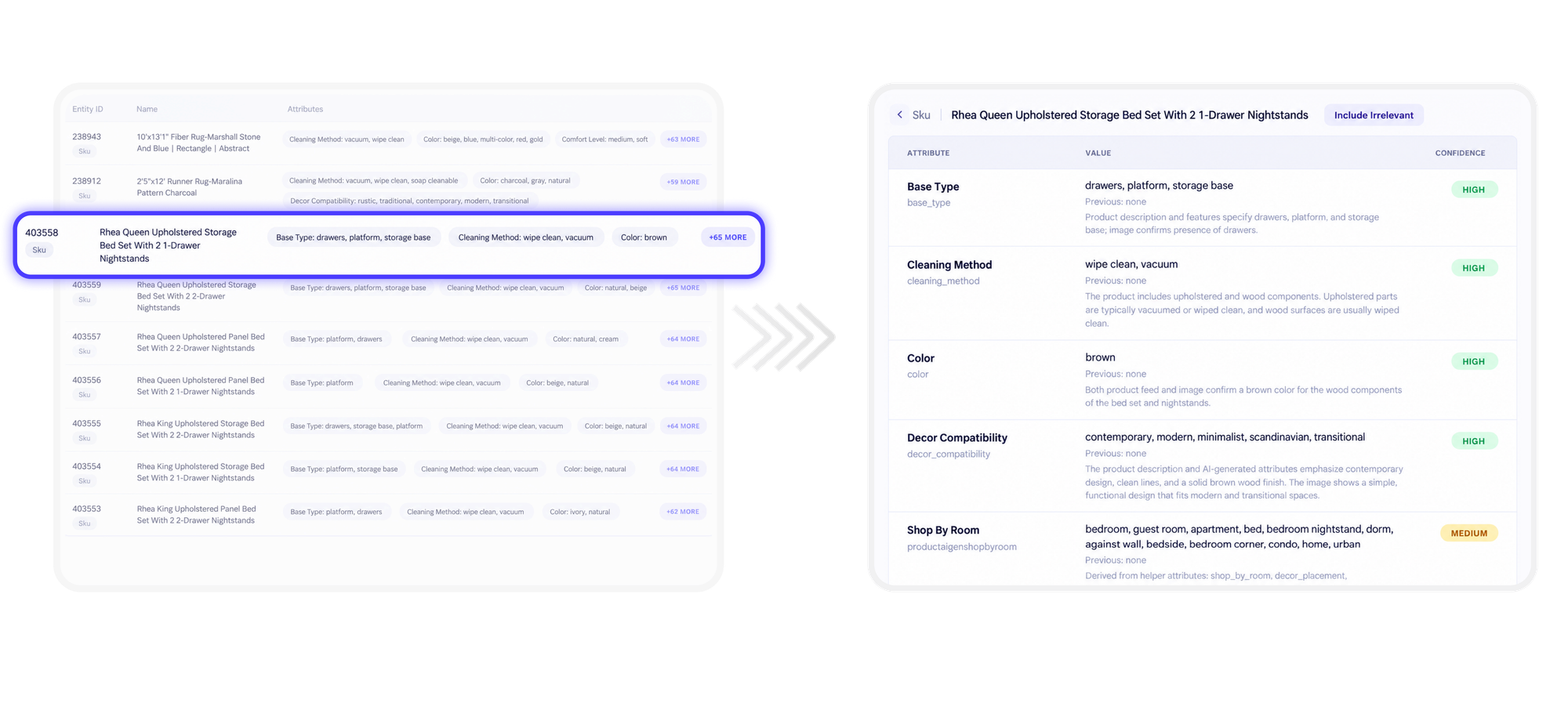
The bigger shift is that your taxonomy can now reflect how shoppers actually search, instead of being limited by how suppliers describe products. Think beyond basic attributes like color or size to things like activity, intended setting, visual style, room, fit, warmth level, or use case.
The result is a richer, more complete catalog that improves onsite navigation, search, filters, personalization, and product discovery.
- AI Discovery module: See where your brand shows up in AI search, which pages earn citations, and how AI referrals translate into traffic and sales, so you know what’s working and where you’re missing opportunities to reach shoppers.
- LLM Recommended Campaigns: Turn AI Discovery insights into suggested campaigns that address gaps in your AI search visibility, with relevant campaign pages proposed in one click. You can review, edit, or reject every page before approving, giving you a faster path from insight to action with full creative control.
- Hub and Spoke Campaigns: Build topical authority with an interconnected hub and supporting comparison, best-of, and how-to pages that Optiversal suggests and generates around the ways people actually search. Shoppers get useful answers throughout their buying journey, while AI gets richer, connected content to understand and reference.
New Resources
• How to self-audit your Google Merchant Center feed with Claude Skills
• How to bring Claude-like experience to your eCommerce Site
• How to get ahead of trends during holiday (without bugging merchandising team or needing dev work)
Where To Find Us
• ShopTalk (Sept 29-Oct 1) in Nashville, TN
• The Direct 60 Forum (Oct 8) in NYC
If you want to see how AI Surfaces are affecting your specific category, you can schedule a 15-minute data audit with our team.