July Recap

How are we already talking about Back to School?
I mean, I'm not mad about it. As a triplet, I have really fond memories of Back to School shopping with my mom. I loved having a massive cart overflowing with 3x of everything (and of course, everything had to be color coded). When it came for the three of us to go to college, one of the dorm room essentials was...drum roll..THE mini fridge. And that single metal box meant two entirely different things depending on who you asked.
To me, a teenager leaving for my freshman year of college, that fridge was a beacon of freedom. It meant late-night pizza rolls, keeping energy drinks ice-cold during midterms (yep, Code Red Mountain Dew to be specific), and finally having my own stash away from my siblings. I was searching things like "cute dorm fridge that fits under a lofted bed."
But to my mom? Buying three of these as her nest suddenly emptied was a different emotional and practical experience. She was looking for safety and utility. She wanted to know if it had a proper freezer for meal prep so we wouldn't skip dinners. She cared about Energy Star ratings and whether three of these things were going to blow the fuses in our respective dorms. She was searching for "safe energy-efficient dorm fridge" and "best value mini fridge with freezer."
Same exact product. Two totally different ways of searching. Two distinct audiences that your on-site content needs to capture. So if your advertising feeds and product pages aren't tailored to speak to both the practical buyer and the enthusiastic end-user this season, you're leaving money on the table.
Spoiler alert: we can help with this 👀.
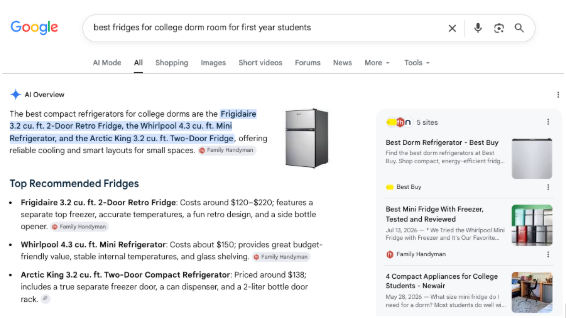
And now being much older, if I was looking for a fridge for my kids going off to college, I'd start with Best Buy as they were the top response in Google's AI Overviews.
🔍 What Happened This Month: The July Search Recap
🤖 Google AI & Search Updates
- Explore New Angles: Google’s AI Overviews now feature a "further exploration" section at the end of answers, pushing links to related resources.
- NOTE: PAA (People Also Ask) and AI Mode act as exploration tools rather than converters. The new "Explore Further" links suffer from an 83% view rate but a 0% click rate right now.
- Ads Taking Over AI Mode: Ad presence in AI Mode has surged to ~30%, spiking to 53.5% on keywords with a $10+ CPC. Formats range from standard text to inline Shopping grids.
- Google Hits #2 in AI Mode Citations: Driven heavily by Google Business Profiles and Product Knowledge Panels, Google is now the 2nd-most cited domain in AI Mode.
- Social Tracked in GSC: You can now monitor your social and video performance (Instagram, TikTok, X, YouTube) directly inside Google Search Console.
- Bot-Protection Indexing Traps: Got an "Are you a robot?" gate? Googlebot might index it as duplicate content instead of your actual page.
- Google seeks to reinvent search as AI competition intensifies with OpenAI. Following their massive search box redesign (which now accepts videos, files, and active Chrome tabs), Google wants to beat OpenAI by leveraging habit. As eMarketer analyst Nate Elliott puts it, "Google wins in AI by convincing people that they don't need to go to a different place to get AI answers."
ICYMI: How 6 top CMOs are working to make their brands show up on AI platforms
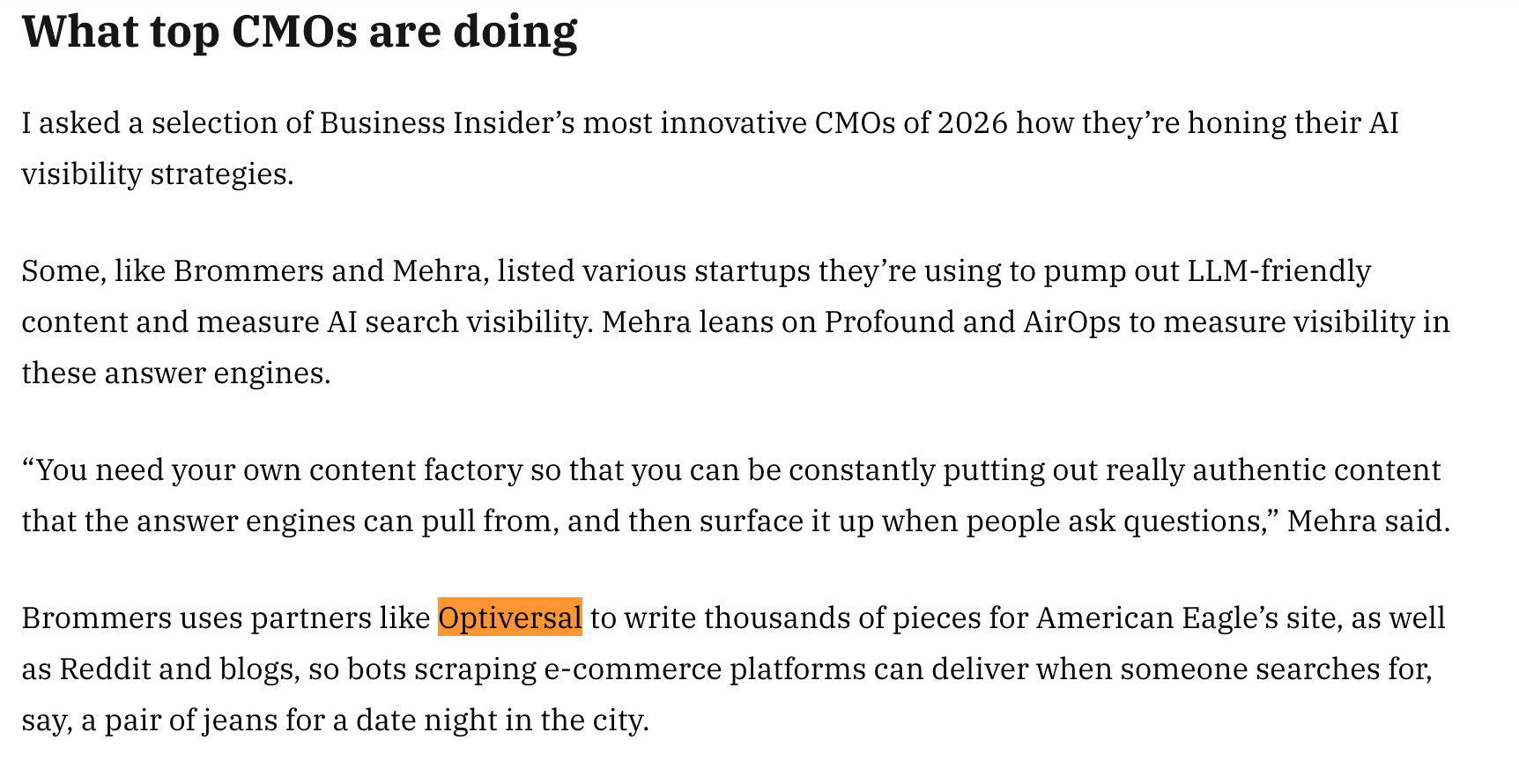
See how leaders like American Eagle's CMO, Craig Brommers, are using tools like Optiversal to capture "hidden demand" by structuring their catalog data specifically for LLMs. They are even spinning up branded, shoppable product apps directly inside ChatGPT so AI agents can recommend their exact SKUs in natural conversation.
Webinar Highlight: The future of AI search and holiday preparedness with Aleyda Solis
Aleyda Solis dropped a crucial reality check for e-commerce brands: treating AI Overviews like traditional search will tank your holiday traffic. Her biggest takeaway is that winning AI real estate, especially during holiday, requires shifting from standard keyword targeting to full-blown entity building. To get your products cited in AI summaries, you need flawless schema markup, hyper-optimized Google Merchant Center feeds, and optimized PDPs that directly answer the conversational, long-tail questions shoppers are actually asking LLMs. If your pages don't instantly prove authority and context, you simply won't make the cut when the holiday shopping rush begins.
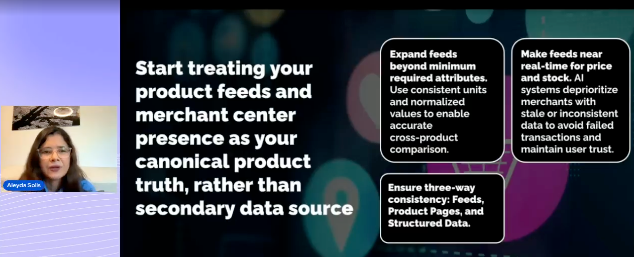
Get your Google Merchant Feed Audit here
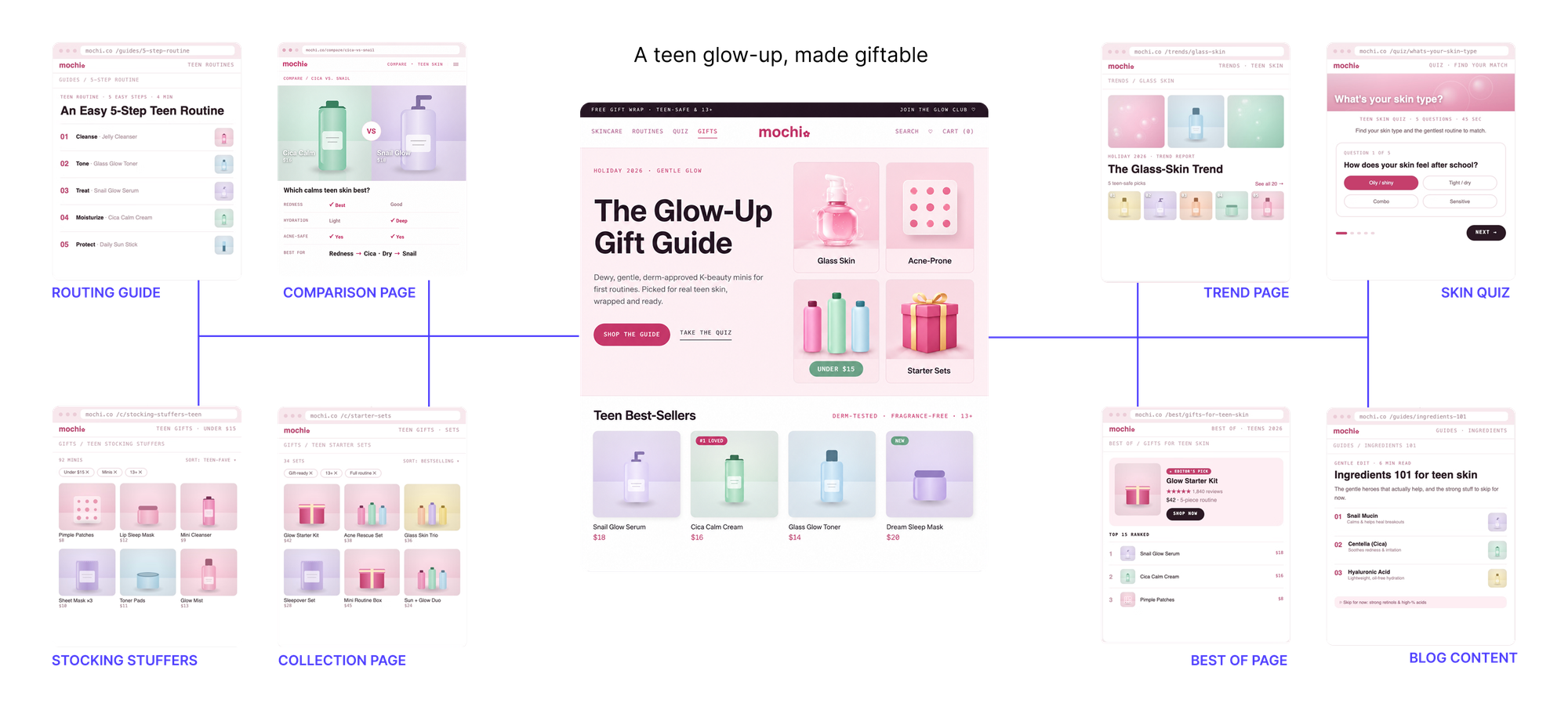
Product Spotlight: Become the topical authority with Hub & Spoke content creation
Optiversal’s new Hub-and-Spoke functionality helps retailers build topical authority around emerging trends, seasonal moments, and high-value shopper needs. Start with one theme or campaign, then use Optiversal agents to identify opportunities and recommend a connected set of pages spanning products, audiences, occasions, use cases, preferences, and comparisons.
Your team can refine the strategy in bulk and publish the entire experience in one click creating more ways to capture demand across AI search, conversational discovery, email, social, ads, affiliate, and seasonal campaigns.
Now available for Optiversal customers.
New Resources
• Holiday Preparedness: A Retailer's Guide to 2026 (eBook)
• The AI-Ready Google Merchant Center Feed (eBook)
Where To Find Us
• Retail Club (Sept 22-24) in Huntington Beach, CA
• eTail Connect West (sept 23-25) in Carlsbad, CA
• ShopTalk (Sept 29-Oct 1) in Nashville, TN
If you want to see how AI Surfaces are affecting your specific category, you can schedule a 15-minute data audit with our team.