Stop Renting Traffic You Should Own

The Hidden Tax Killing Your Margins
Every day your paid media budget fills a hole that organic search should have covered. That's not a strategy. That's a "subscription" to someone else's house.
8 min read · eCommerce Leadership · Paid Media & SEO
By Michele Nieberding at Optiversal
There's a number that lives inside your blended CAC report. It doesn't have a label. It doesn't have a line item. But it's there, quietly bleeding your margins every single month. It's the cost of buying traffic you should already own.
Let me know if this sounds familiar...your performance marketing team is sharp. They're running tight creative, optimizing bids, pulling levers you didn't even know existed. And still...the CPCs creep up, the ROAS edges down, and the CFO starts asking uncomfortable questions in the QBR. UGH... So you add more budget to compensate. Rinse, repeat.
But what nobody realized is that you're not losing because your ads are bad. You're losing because you're paying Google for a seat at a table you should already be sitting at for free.
The House You Never Built
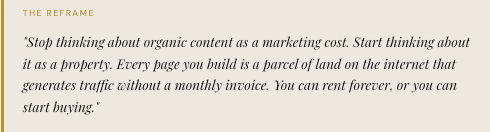
Think about the difference between renting an apartment and owning a home. You know this story. The renter pays every single month, builds zero equity, and the moment they stop paying, they're out. The homeowner pays too, but they're building something. Every mortgage payment is a stake in something permanent. Something that compounds. Something that one day pays them back (and hopefully pays more than what they paid initially!).
Your paid media budget is rent. And your organic search presence is the house you've been too busy to build.
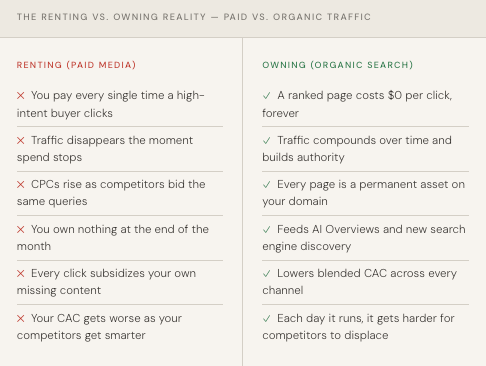
Most retailers are still renting, and they don't even know how much of their house they're missing.
The Quiet Crisis in Your Catalog
Here's what's actually happening inside your funnel right now. A high-intent buyer types "women's waterproof hiking boots wide width for summer vacation in Patagonia" into Google. That's not a casual browser. That's a buyer. That's the kind of specificity that tells you a wallet is already halfway out of a pocket.
Do you have an organic page for that? Not just a category page with a filter. A real, indexed, search-optimized landing page built for that exact query, with the right products, the right copy, the right structure...one that Google actually trusts enough to surface?
For most retailers, the honest answer is no. And so your performance marketing team has to buy that click. Every. Single. Time.
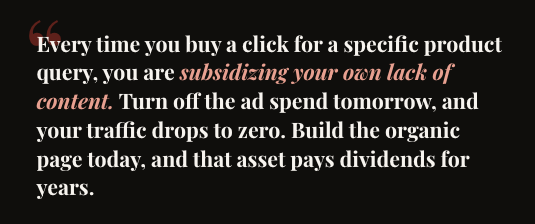
This isn't a traffic problem. It's an asset problem.
Your catalog is full of thousands of high-intent long-tail queries that your buyers are actively searching and you have no organic home for any of them. So your paid team fills the gap. Month after month. With someone else's money. On someone else's platform. Building equity for Google, not for you.
What This Does to Your Blended CAC
CMOs understand blended Customer Acquisition Cost in their bones. It's the number that tells the real story, not just what a single channel costs, but what it truly costs to win a customer across your entire operation/customer journey.
When your organic search presence has blind spots, every one of those blind spots becomes a paid media expense. Your performance team (doing exactly what they're supposed to do) steps in to cover the queries that should already be yours. And they do it with expensive, high-CPC keywords. Long-tail, high-intent, specific-product queries that command premium bids because the buyer on the other end is ready to convert.
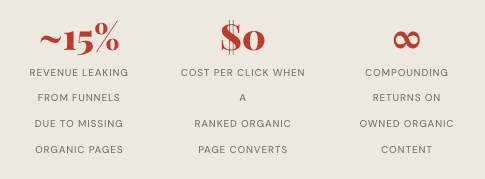
Now look at what that does to your blended CAC. The paid spend you're using to cover organic gaps inflates your average acquisition cost across every channel. Your most efficient organic revenue, the kind that costs almost nothing, is being replaced by some of the most expensive clicks in your entire media mix. And because your generic product feeds hurt your relevancy scores, you're forced to bid even higher to overcome the deficit.
You're paying a data tax. And it compounds every single quarter.

The Competitor Who Isn't Better Than You, Just Better Structured
This is the part that stings. The brands eating your lunch right now are not smarter than you. Their product isn't better. Their prices aren't always lower. They are not outspending you on paid media in a way that should make sense.
They are simply better structured. Their product data is richer. Their catalog is more legible to search engines and AI systems. They built the pages. And now those pages are quietly capturing the buyers that should have been yours sliding into AI Overviews, surfacing in organic results, appearing in the new AI-powered search engines that your buyers are already using more than you think.
The machine (whether that's Google, ChatGPT, Perplexity, or whatever comes next, smh) is making recommendations based on the data it can actually read. Brands with enriched catalogs and structured organic pages are the ones getting recommended. The others are invisible. And the invisible ones are compensating with paid spend.
The Compounding Cost of Waiting
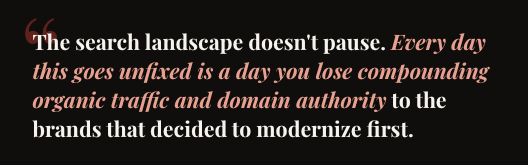
Here's what makes this genuinely urgent, not just theoretically important: the search landscape does not pause.
Every day you don't build the organic pages, a competitor does. Every day their pages sit indexed and ranking, they accumulate authority. Backlinks find them. Google trusts them more. AI systems learn to surface them. By the time you decide to build your own pages, you're already starting behind. And the cost of catching up is steeper than the cost of moving first.
Domain authority compounds just like interest. The brands who built the organic infrastructure early are now earning it on autopilot. The brands who waited are still renting, and their rent keeps going up.
What Good Actually Looks Like
The shift is not complicated in concept, even when the execution requires real work. It's a mindset change from "marketing spend" to "asset building."
Imagine your performance marketing team bidding on fewer long-tail queries. Not because they're cutting back, but because those queries now have organic homes. Highly specific, deeply structured landing pages built from your actual product catalog. Pages that answer exactly what a high-intent buyer is searching for. Pages that rank. Pages that convert. Pages that cost nothing to click. HEAVEN!
Now imagine that for every expensive long-tail keyword your paid team was buying, there's a permanent organic page that captures that same buyer for $0. Your blended CAC drops. Your paid budget gets redeployed to top-of-funnel where it actually belongs — driving awareness, not filling organic holes. And every page you publish today is a compounding asset that gets more valuable as the months pass.
| The CMO's Problem | What's Actually Causing It | What Owned Traffic Changes |
|---|---|---|
| "I need to lower my blended CAC" | Buying ads for specific long-tail queries because no organic pages exist for them — renting traffic that should already be owned | Compounding organic assets convert expensive paid clicks into permanent $0-CPC traffic. High-intent buyers captured permanently. |
| "My paid efficiency is declining quarter over quarter" | Generic product feeds lower relevancy scores, forcing higher bids to overcome the deficit — a literal data tax on every auction | Enriched catalog data improves quality scores, lowers required bids, and lets paid budget work on what it's actually good at |
| "Competitors are winning placements we should have" | Their structured content is easier for Google and AI systems to read and recommend — your catalog is invisible to the machine | Structured, specific landing pages surface in AI Overviews, organic rankings, and emerging AI search — owned, not rented |
| "We can't keep scaling with paid alone" | The organic gap grows every month it goes unaddressed — and paid spend is the only thing filling it | Owned organic content is the only channel that compounds. Every page published today returns more next year than this one. |
The Decision in Front of You
You have two paths. You can keep renting, aka keep funding the paid media machine, keep watching CPCs creep upward, keep explaining to the board why CAC is climbing even as the team works harder than ever. It's a perfectly coherent strategy for a while. Until it isn't.
Or you can start building. Not all at once. Not by overhauling everything in a single quarter. But by systematically converting your catalog into organic search assets such as landing pages that your buyers are already searching for, that your competitors are slowly claiming, that AI systems are already learning to surface.
The technology exists to do this at scale. To automatically discover the keyword opportunities hiding inside your product catalog. To build thematic, high-quality landing pages that match your brand voice and your site structure. To monitor, prune, and compound over time. To turn what is currently your biggest organic liability into your most durable growth asset.
The only question is whether you start before or after the competitor sitting next to you at the next industry conference does.
The brands that win the next three years of eCommerce will not be the ones who spent the most on paid media. They'll be the ones who recognized that paid is a tool and built the organic infrastructure to stand on their own.
You've been renting long enough. It's time to own.
Your catalog is full of
traffic you're not capturing.
The high-intent buyers searching for exactly what you sell are out there right now. The question is whether they find your page or a competitor's paid ad that leads to a page that should have been yours.